
Build a reusable video library
Upload, search, preview, download, reformat, and reuse media in the managed File Manager, then connect the same asset to one player, many player groups, or several business use cases over time.
Turn uploaded or recorded video into a managed on-demand library. Organize assets and playlists, publish a branded player on your site, control who can watch, and deliver the same catalog across devices without building a separate playback stack.
Upload, search, preview, download, reformat, and reuse media in the managed File Manager, then connect the same asset to one player, many player groups, or several business use cases over time.
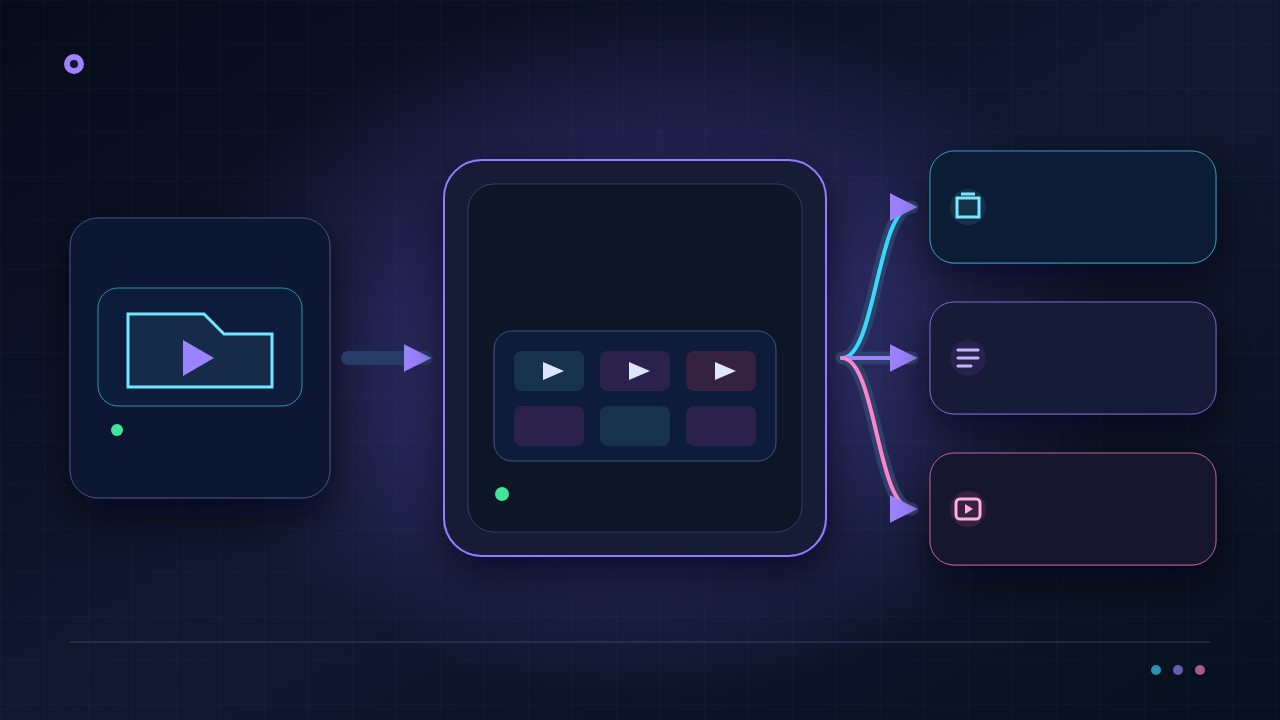
Upload, search, preview, download, reformat, and reuse media in the managed File Manager, then connect the same asset to one player, many player groups, or several business use cases over time.
Upload, search, preview, download, reformat, and reuse media in the managed File Manager, then connect the same asset to one player, many player groups, or several business use cases over time.
Use a player surface that stays consistent across browsers and screen sizes instead of rebuilding playback logic for every destination.
Set branding and choose open, password, email-and-password, or unique-credential access for the playback surface instead of building those controls from scratch.
Keep playback stable for distributed audiences while preserving one player model and one operational surface for your team.
Use paywalled playback when a single video, playlist, or grouped page needs access control instead of open public playback.
Use adaptive playback so the same asset can remain watchable across a wide range of viewer connections and devices.
Keep assets on the instance or connect reviewed AWS S3 and Backblaze targets. Copy managed files between storage destinations so retention, migration, and persistence stay explicit.
Supported behavior sits beside a practical acceptance check. The installed Callaba interface and the real source, destination, and infrastructure profile remain authoritative.
| Capability | Supported behavior | Acceptance check |
|---|---|---|
| Build a reusable video library | Upload, search, preview, download, reformat, and reuse media in the managed File Manager, then connect the same asset to one player, many player groups, or several business use cases over time. | In practice you use all three. File Manager holds and prepares the assets, players define playback and access behavior, and grouped playback pages organize what viewers actually see. |
| Publish one player across devices | Use a player surface that stays consistent across browsers and screen sizes instead of rebuilding playback logic for every destination. | Yes. You can start with managed player surfaces, branding controls, and access settings before deciding whether you need a deeper custom frontend layer. |
| Monetize selected assets or collections | Use paywalled playback when a single video, playlist, or grouped page needs access control instead of open public playback. | Yes. That is one of the main reasons to use grouped playback surfaces instead of exposing only raw files or one-off embeds. |
| Control branding and access | Set branding and choose open, password, email-and-password, or unique-credential access for the playback surface instead of building those controls from scratch. | Yes. You can start with managed player surfaces, branding controls, and access settings before deciding whether you need a deeper custom frontend layer. |
| Adapt playback to connection quality | Use adaptive playback so the same asset can remain watchable across a wide range of viewer connections and devices. | High-quality videos enhance audience retention, improve user experience, and can increase conversion rates and subscriptions to paid services. |
| Keep files and storage under control | Keep assets on the instance or connect reviewed AWS S3 and Backblaze targets. Copy managed files between storage destinations so retention, migration, and persistence stay explicit. | Start with Files for asset control, continue with Web players , and use Web player groups when one playback surface should combine several assets or languages. |
You have seen what the product does. These three guides take you into the exact controls, show what to connect next, and give you a practical check before the workflow goes live.
Keep assets on the instance or connect reviewed AWS S3 and Backblaze targets. Copy managed files between storage destinations so retention, migration, and persistence stay explicit.
The pay-as-you-go cloud tariff is ideal for those who need all the advantages of the cloud, such as instant deployment of Callaba, low latency due to the global network of data centers, server reliability, data backup, scalability, managed services, and much more.
The unlimited tariff is a good fit for actively growing broadcasting organizations of medium and large size that would like to have no limitations like those in the bundled tariff, while also maintaining full control over their data.
A real VOD product is not one upload endpoint. In practice, teams manage files, players, grouped playback pages, branding, and storage as separate workflow pieces. Use the API when playback needs to behave like part of your own app, CMS, or customer portal.
In practice you use all three. File Manager holds and prepares the assets, players define playback and access behavior, and grouped playback pages organize what viewers actually see.
Yes. You can start with managed player surfaces, branding controls, and access settings before deciding whether you need a deeper custom frontend layer.
Yes. That is one of the main reasons to use grouped playback surfaces instead of exposing only raw files or one-off embeds.
Start with Files for asset control, continue with Web players, and use Web player groups when one playback surface should combine several assets or languages.
High-quality videos enhance audience retention, improve user experience, and can increase conversion rates and subscriptions to paid services.
VOD is not automatically free. A software module or trial can have its own price, while the audience-facing service also needs delivery bandwidth, storage, transcoding, and usually a player or CDN. Check those infrastructure costs separately from the Callaba deployment or module cost.
Start with a media library, an encoding and delivery plan, a browser player, and the access rules your audience needs. Then connect the player to your site and test upload, playback, entitlement, and delivery costs with real media before opening it to viewers.
A VOD channel is an organised collection of on-demand programmes that viewers choose and play when they want, rather than a scheduled live channel. It can be public, restricted, or tied to a subscription or purchase rule.
Video on demand (VOD) is video a viewer chooses to play when ready rather than a live scheduled feed. “VODs” is the plural. A vodcast is commonly a podcast-style programme distributed as video; it can be published as on-demand media, but the term does not describe a separate playback technology.