
Real-time bitrate
Illustrative live view6.2 Mb/sLive · last 60 seconds
Deploy Callaba RTMP Server in the cloud or self-host it on Linux. Give OBS, software encoders and external publishers a stable listener with a dedicated port, configurable player buffer, and stream-key or IP allowlists; then send the accepted feed to playback, recording, restreaming, or another Callaba workflow.
The RTMP listener is the stable ingest boundary. Packaging and downstream modules turn that accepted feed into the production output you choose.
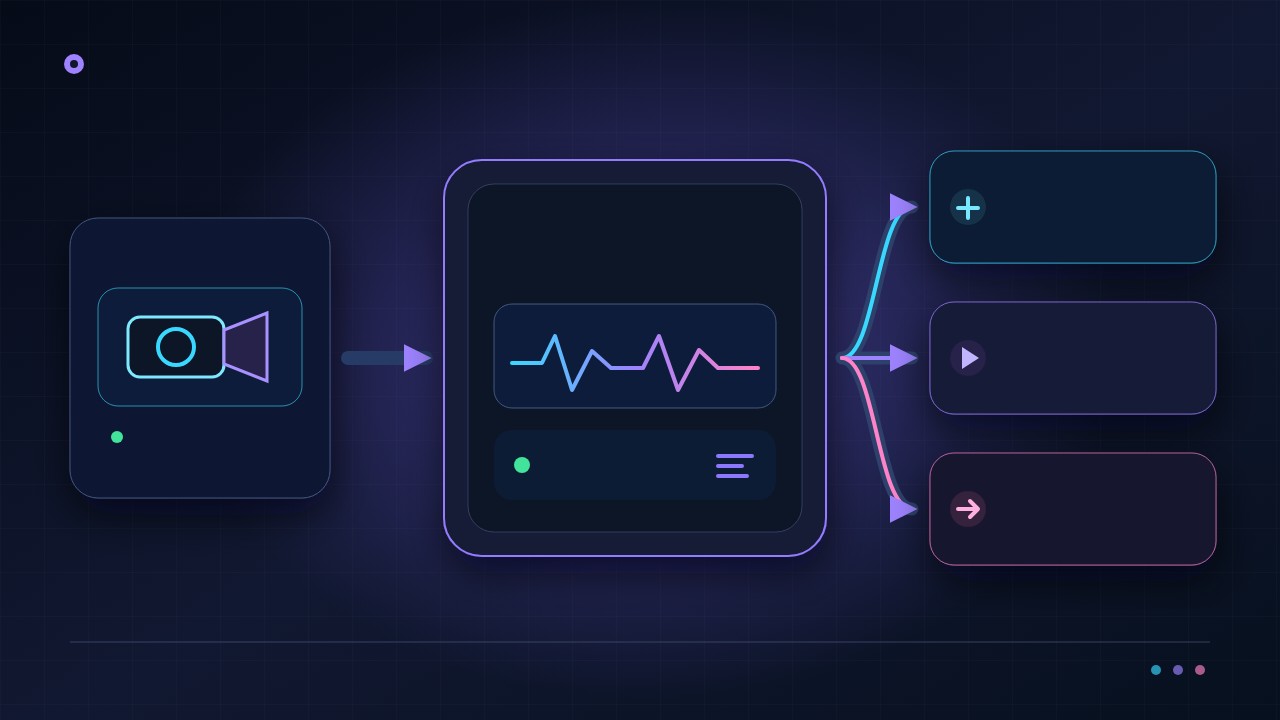
Start with one sender on an unused TCP port, then watch bitrate, connection region and IP address before expanding the workflow.
See where each publisher or receiver connects from and the network address it uses.
203.0.113.42Allow only approved stream keys or IP addresses, with separate rules for publishers and receivers.
Enable guest RTMP so publishers and receivers can create their own connections with any stream key—without pre-registering each key.
Guest mode enabledUse a concrete server resource instead of treating an RTMP URL as an unmanaged string. Each listener can be configured, enabled, stopped and connected to the rest of the Callaba workflow.
Assign an unused TCP listen port. For the first OBS or encoder sender, create a stream with the Publisher role and use the RTMP URL and stream key configured for it.
Use stream-key validation when admitting a publisher by its configured identifier. Choose an IP rule for a known, stable host; Receiver access is separate.
Start or stop the server while Callaba maintains its runtime configuration and the related HLS and DASH output directories.
Supported behavior sits beside a practical acceptance check. The installed Callaba interface and the real source, destination, and infrastructure profile remain authoritative.
| Capability | Supported behavior | Acceptance check |
|---|---|---|
| Dedicated RTMP listener | Assign an unused TCP listen port. For the first OBS or encoder sender, create a stream with the Publisher role and use the RTMP URL and stream key configured for it. | It creates a stable RTMP listener for OBS, software encoders and other publishers, applies the selected stream-key or IP access rule, and makes the accepted feed available to playback, recording and routing workflows in Callaba. |
| Publisher and receiver allowlists | Use stream-key validation when admitting a publisher by its configured identifier. Choose an IP rule for a known, stable host; Receiver access is separate. | Yes. The RTMP server supports explicit allowed-stream rules based on stream identifiers or fixed IP addresses. These controls restrict publishers and receivers; they are not a substitute for transport encryption. |
| Lifecycle and packaging | Start or stop the server while Callaba maintains its runtime configuration and the related HLS and DASH output directories. | No. Start with the Callaba product workflow and validate a real publisher, access rule and destination. Use the API only when server lifecycle actions need to be automated inside another application or operator panel. |
| HLS or DASH playback | Prepared packaging directories support player delivery workflows. | No. The current Callaba RTMP Server product and API contract documented here is for RTMP. Do not assume RTMPS termination. Use an independently verified TLS boundary or choose Callaba SRT Server when encrypted, resilient contribution over the public internet is required. |
| Recording | Use the accepted feed as the source for a recording workflow. | No. Start with the Callaba product workflow and validate a real publisher, access rule and destination. Use the API only when server lifecycle actions need to be automated inside another application or operator panel. |
| Restream or handoff | Use Restream when the next job is a separately configured destination. | It creates a stable RTMP listener for OBS, software encoders and other publishers, applies the selected stream-key or IP access rule, and makes the accepted feed available to playback, recording and routing workflows in Callaba. |
You have seen what the product does. These three guides take you into the exact controls, show what to connect next, and give you a practical check before the workflow goes live.
Prove the source, access rule and output workflow in the environment that matches your operational and networking requirements.
Deploy Callaba in the cloud when you need a reachable RTMP ingest point quickly and want to validate the complete workflow before sizing fixed infrastructure.
Deploy Callaba on AWSInstall Callaba on infrastructure you control when port exposure, private networking, storage location or long-running capacity must stay in your environment.
Install Callaba on your Linux serverThe secondary API layer can create, inspect, update, start, stop and remove RTMP server resources. Define the real ingest and access policy in the product first, then integrate those lifecycle actions into your operator tools.
It creates a stable RTMP listener for OBS, software encoders and other publishers, applies the selected stream-key or IP access rule, and makes the accepted feed available to playback, recording and routing workflows in Callaba.
Yes. The RTMP server supports explicit allowed-stream rules based on stream identifiers or fixed IP addresses. These controls restrict publishers and receivers; they are not a substitute for transport encryption.
No. The current Callaba RTMP Server product and API contract documented here is for RTMP. Do not assume RTMPS termination. Use an independently verified TLS boundary or choose Callaba SRT Server when encrypted, resilient contribution over the public internet is required.
No. Start with the Callaba product workflow and validate a real publisher, access rule and destination. Use the API only when server lifecycle actions need to be automated inside another application or operator panel.
Deploy on AWS, install on Linux, or inspect the Multiview operator experience before you automate the workflow.