

Related vendor hub
Browse all PTZOptics SRT gateway workflows
Use the PTZOptics hub to compare Studio Pro, Link 4K, Move SE, and Move 4K SRT workflows.
For a PTZOptics Studio Pro SRT setup, use the camera as an SRT Caller and send its IP stream to Callaba Gateway as the cloud SRT Listener. Use this setup when Studio Pro is at the venue and Callaba is the cloud SRT receiver for monitoring, recording, routing, multiview, or restreaming. The main path is direct SRT; before the event, confirm that the installed firmware exposes the expected SRT streaming modes and fields.
Quick answer
To use PTZOptics Studio Pro with SRT, set Studio Pro as the SRT Caller and send the stream to a cloud SRT Listener. In this guide, Callaba works as the SRT gateway, receiver, monitor, recorder, and routing layer.
The PTZOptics Studio Pro sends one SRT contribution feed into Callaba. After ingest, Callaba can preview, record, route, multiview, and restream the same source in parallel.
- Studio ProSRT Caller at venue
-
Callaba GatewaySRT Listener in cloud
- Preview
- Record
- Route
- Multiview
- Restream
What this setup does
Studio Pro acts as the camera encoder. Callaba acts as the cloud SRT receiver, then makes the received feed available for operational tasks such as preview, multiview, recording, routing, playback, and restreaming. These are downstream options after ingest; you do not need to configure them in a fixed chain.
This is useful when the camera is on a venue network and your production team needs a controlled receiver point outside the venue, with live statistics and routing choices after the feed arrives.
What this model can and cannot do in this workflow
For this exact model, PTZOptics documentation lists SRT, RTMP/RTMPS, RTSP, ONVIF, multicast, and NDI HX3. The Studio Pro product page also describes NDI HX3 as native and says no additional license is needed to access the camera over the network.
- Confirmed direct path: SRT from Studio Pro to a cloud listener such as Callaba.
- SRT roles: PTZOptics Gen 3 Web UI documentation lists Caller and Listener mode. Rendezvous mode is not listed in the public Studio Pro/Gen 3 settings I found, so do not design around it unless the installed firmware visibly offers it.
- SRT security fields: AES-128, AES-192, AES-256, SRT password, latency, bandwidth overhead, and optional Stream ID are documented in the Gen 3 streaming settings.
- Video and audio: official specs list H.264, H.265/HEVC, MJPEG, YUY2, and AAC audio. The same specs limit H.265/HEVC to RTSP/NDI HX3, so I would start the SRT workflow with H.264 unless PTZOptics support confirms otherwise for your firmware.
- Physical outputs: exact-model connection/spec pages list HDMI output, USB-C 3.0 UVC output, and RJ45/IP networking. They do not list a physical SDI output or ST 2110 output for Studio Pro.
- Receiver requirement: no vendor receiver or vendor cloud layer is required for the SRT workflow. Studio Pro can send to Callaba directly when the SRT menu is present.
One model distinction matters: do not copy 4K or SDI assumptions from Studio 4K or other PTZOptics Studio-family material onto Studio Pro. Some public wording can look generic, while the exact Studio Pro technical and connection pages describe a 1080p camera with HDMI, USB-C, and IP outputs.
Recommended workflow
Use Studio Pro as the SRT Caller and Callaba as the SRT Listener. This keeps the venue side outbound, which is usually easier than accepting inbound UDP at the camera location. Create the SRT server in Callaba, open the selected UDP port, then paste the Callaba host, port, passphrase, and Stream ID into the camera if those fields are used.
Use camera Listener mode only when the venue network can accept inbound UDP and you have tested public IP, NAT, firewall, and port-forwarding behavior. For most remote contribution jobs, Caller from the camera to a cloud listener is the safer first design.
When not to use this setup
- If the camera and switcher are on the same LAN, local HDMI, USB-C UVC, or NDI HX3 may be simpler than cloud contribution.
- If the only destination is a public platform and you do not need cloud monitoring, recording, routing, or multiview, the camera RTMP/RTMPS output may be enough.
- If the SRT menu is missing on the installed firmware, update firmware first or use RTMP/RTMPS as the direct fallback. RTSP or NDI HX3 can also be bridged when the production design needs a local bridge.
- If you need SDI or ST 2110 from the camera body, Studio Pro is not the right exact model based on the public connection/spec pages.
Before you start
- Confirm the camera firmware and that Streaming Settings expose SRT, Caller/Listener mode, encryption, SRT password, latency, bandwidth overhead, and Stream ID.
- Use wired Ethernet where possible. SRT can recover from loss, but a stable uplink still matters.
- Choose a UDP port in Callaba and allow it through any cloud firewall or security group.
- Decide whether to use encryption and Stream ID. Passphrases and Stream IDs are case-sensitive and whitespace-sensitive; a copied newline or trailing space can break the SRT handshake.
- For a first internet test, start with 250-500 ms SRT latency, then lower it only after RTT, packet loss, retransmits, and preview are stable.
- Check audio source selection on the camera. Studio Pro has a built-in microphone and a 3.5 mm line-level input; confirm AAC audio reaches Callaba before the event.
Create the Callaba ingest
- In Callaba, create an SRT server for the Studio Pro feed.
- Use Listener mode on the Callaba side and select a UDP port.
- If required by your workflow, set a passphrase and Stream ID in Callaba.
- Start the server and note the public IP address or DNS name, UDP port, Stream ID, and passphrase.
At this point Callaba is waiting for the Studio Pro SRT Caller. You should not see a stable incoming bitrate until the camera starts sending.
Configure Studio Pro
- Open the PTZOptics camera web UI and go to the Gen 3 Web UI Streaming Settings area.
- Enable SRT and set the camera to Caller mode.
- Enter the Callaba host in the Server field and the Callaba UDP port in the Port field.
- Match encryption and SRT password with Callaba if encryption is enabled.
- Enter the Stream ID only if your Callaba SRT server expects one.
- Set SRT latency in milliseconds. Start with 250-500 ms for internet contribution.
- Start the stream and check Callaba for incoming connection, bitrate, preview, and audio meters.
For bitrate, start around 4-6 Mb/s for 1080p30 or 6-8 Mb/s for 1080p60 if the uplink supports it, then adjust for the venue network and production quality target. If the camera exposes keyframe or GOP settings, a 2-second keyframe interval is a practical first test.
Settings table
| Where | What to do / field to fill | First-test value | Why / check |
|---|---|---|---|
| Callaba | Create SRT server and choose UDP port | Listener on a known open port | Studio Pro needs a reachable cloud listener. |
| Studio Pro Streaming Settings | Caller/Listener mode | Caller | Keeps the venue connection outbound. |
| Studio Pro Streaming Settings | Server | Callaba public IP or DNS name | Must point to the Callaba SRT server. |
| Studio Pro Streaming Settings | Port | Same UDP port as Callaba | Port mismatch usually means no connection. |
| Studio Pro Streaming Settings | Encryption | Off for bench test, then AES-128/192/256 if required | Encryption mode must match the receiver. |
| Studio Pro Streaming Settings | SRT password | Exact Callaba passphrase | Case and whitespace must match exactly. |
| Studio Pro Streaming Settings | Latency | 250-500 ms | Increase for lossy links; reduce only after statistics are clean. |
| Studio Pro Streaming Settings | Stream ID | Blank unless Callaba requires it | Optional, but exact matching matters when used. |
Monitoring
In Callaba, confirm connection uptime, incoming bitrate, preview video, audio meters, RTT, packet loss, and retransmits. A connected SRT socket without stable bitrate usually points to codec, stream start, or camera-side encoding settings. Stable bitrate with no audio means the SRT path is alive but audio source or codec settings need attention.
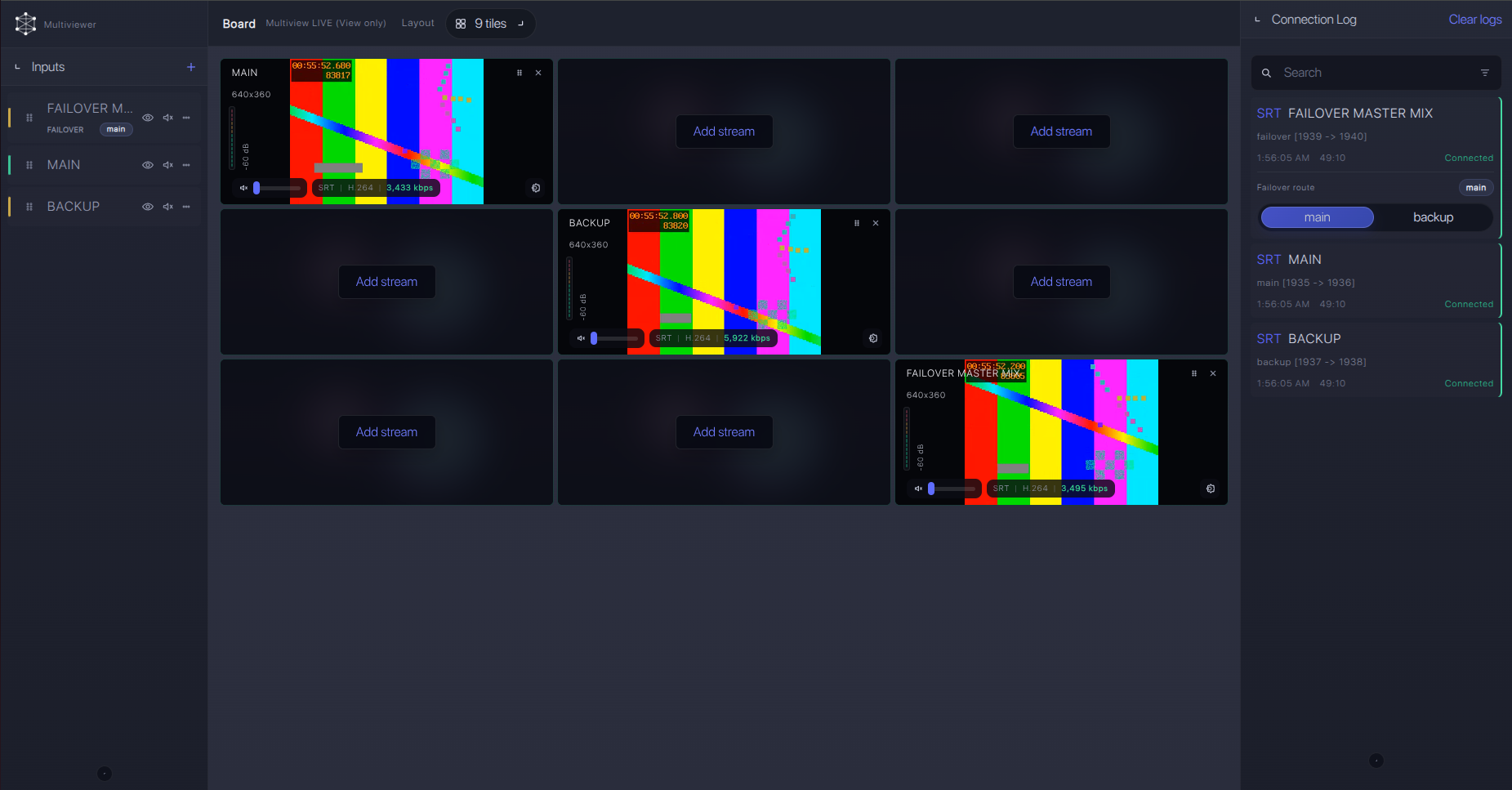
Failover and local ingest options
For production events, plan what happens if the main encoder, venue uplink, or primary contribution path fails. Callaba can be part of that continuity plan without changing the basic PTZOptics Studio Pro ingest workflow.
Recording and playback
After the SRT ingest is stable, create recording, web playback, multiview, restreaming, or routing outputs from the same Callaba source. Treat these as parallel downstream uses. For example, you can record the Studio Pro feed while also sending it to a producer preview and a separate program destination.
Troubleshooting
| Symptom | Check in Callaba | Check on Studio Pro | Likely fix |
|---|---|---|---|
| No connection | SRT server is started; UDP port is open; no incoming packets | Caller mode, Server, and Port | Fix firewall/security group, public IP/DNS, or port mismatch. |
| Handshake fails or drops | Connection attempts, logs, Stream ID requirement | Encryption, SRT password, Stream ID | Match AES mode, passphrase, and Stream ID exactly; remove trailing spaces. |
| Connects but video breaks up | RTT, packet loss, retransmits, incoming bitrate | Bitrate, latency, wired network | Lower bitrate, raise latency, and avoid congested Wi-Fi. |
| Video without audio | Audio meters and recorded file audio | Built-in mic/3.5 mm input selection and AAC audio | Select the intended audio source and retest with meters visible. |
| SRT menu is missing | Use RTMP/RTMPS ingest or prepare a bridge path | Firmware version and Streaming Settings menu | Update firmware if available; otherwise use confirmed RTMP/RTMPS, RTSP, or NDI HX3 workflow. |
| Correct fields but no stable SRT | Callaba server build/support information | Firmware notes or vendor support for SRT library details | Confirm compatible SRT major versions and retest encryption off on a bench network. |
Official references
These are useful references for checking the exact model, firmware menus, and protocol behavior before a production day.
Vendor references
- PTZOptics Studio Pro product page
- PTZOptics Studio Pro technical specs
- PTZOptics Studio Pro streaming documentation
- PTZOptics Studio Pro connections
- PTZOptics Gen 3 Web UI streaming settings
- PTZOptics Gen 3 Web UI NDI settings
Protocol reference
Callaba resources
FAQ
Can PTZOptics Studio Pro send SRT directly to Callaba?
Yes. PTZOptics lists SRT for Studio Pro, and the Gen 3 Web UI streaming documentation includes SRT settings. Confirm the installed firmware and visible SRT menu before the event.
Should Studio Pro be the SRT Caller or Listener?
Use Studio Pro as the SRT Caller and Callaba as the cloud Listener for most internet jobs. Studio Pro Listener mode is documented, but it requires the camera side to accept inbound UDP, which is harder on many venue networks.
Does Studio Pro support SRT Stream ID and passphrase?
The Gen 3 streaming settings document optional Stream ID, SRT password, and AES-128/192/256 encryption. Stream ID and passphrase must match Callaba exactly, including capitalization and whitespace.
What if the SRT menu is missing on my Studio Pro?
Check firmware and vendor support first. If you cannot expose SRT on the unit, use RTMP/RTMPS as the direct fallback, or bridge RTSP/NDI HX3 to Callaba when that fits the production design.
Can I use NDI instead of SRT?
Yes on a suitable LAN: Studio Pro is documented with NDI HX3. For remote cloud contribution, NDI normally needs a bridge or transport layer, while SRT can go directly to Callaba over the public internet.
Is H.265 the right codec for Studio Pro SRT?
I would start SRT with H.264. PTZOptics technical specs list H.265/HEVC for RTSP/NDI HX3, so do not assume HEVC over SRT unless your firmware and vendor documentation explicitly confirm it.
Next steps
Bench-test the camera, Callaba server, passphrase, Stream ID, audio source, bitrate, and latency on the same firmware you will use for the event. After the SRT ingest is stable, add recording, preview, multiview, restreaming, and routing outputs one at a time so each downstream path is easy to verify.
