Free Streaming Software
More live video workflow notes and product updates.

Free streaming software can be a strong starting point for production teams, but only when you evaluate it through reliability, operations, and growth constraints instead of feature screenshots. This guide gives an engineering-first framework for selecting, deploying, and scaling free tools without creating technical debt you cannot unwind later. For this workflow, teams usually start with Paywall & access and combine it with 24/7 streaming channels. Before full production rollout, run a Test and QA pass with Generate test videos and streaming quality check and video preview. Before full production rollout, run a Test and QA pass with a test app for end-to-end validation.
What this article solves
Most teams start with free tools under time pressure. The first event works, but the second month fails: unstable ingest, weak fallback, no monitoring, and manual reconfiguration for every stream. The issue is rarely the software alone. It is usually missing architecture boundaries and operational policy. This article helps you make free software work as part of a production system.
Use the bitrate calculator to size the workload, or build your own licence with Callaba Self-Hosted if the workflow needs more flexibility and infrastructure control. Managed launch is also available through AWS Marketplace.
Recommended platform route: Ingest and route, Player and embed, Video platform API.
Evaluation framework before adoption
- Contribution reliability: can the tool hold stable output during jitter and packet loss?
- Profile discipline: can you enforce standardized bitrate, GOP, and keyframe settings?
- Operational repeatability: can operators reuse templates safely across events?
- Recovery behavior: is reconnect and failover predictable under endpoint outages?
- Integration depth: can you connect it to routing, access policy, and analytics layers?
Baseline architecture for low risk
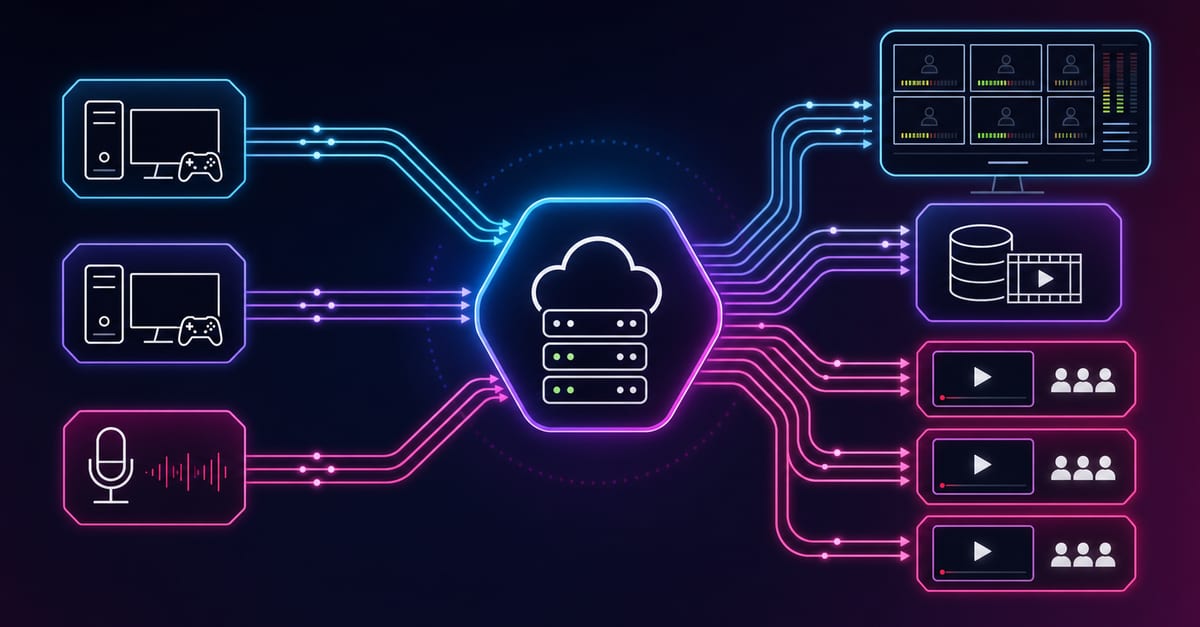
A practical baseline is simple: free software for source encoding, controlled ingest endpoint for contribution, routing layer for destinations, and a separate playback layer for end users. This split prevents configuration chaos and lets teams improve one layer without destabilizing the rest.
- Encoder layer: profile-controlled output and tested fallback profile.
- Ingest layer: primary and backup endpoints with health checks.
- Distribution layer: policy-driven fan-out to platforms and owned properties.
- Playback layer: stable player config with session analytics.
Supporting references: best streaming software, video encoder strategy, restream architecture.
How to avoid hidden cost explosions
Free software can still produce expensive outcomes when operations are manual. The biggest hidden costs are staff time, incident handling, and audience churn after unstable sessions. Define measurable limits from day one:
- Maximum acceptable reconnect events per hour.
- Startup delay and rebuffer SLO targets per audience class.
- Profile change policy with rollback and approval workflow.
- Per-event postmortem checklist with owner and due date.
Common mistakes and fixes
- Mistake: one global profile for all content types.
Fix: create profiles per content class: talk, mixed, high motion. - Mistake: no backup ingest path.
Fix: provision standby endpoint and test failover before every event. - Mistake: operator-specific local presets.
Fix: centralize preset ownership and versioning. - Mistake: free tool directly handles monetization flow.
Fix: separate paywall/access to dedicated policy layer.
Rollout plan teams can execute
- Start with one recurring stream and fixed profile set.
- Instrument ingest health, startup delay, and output availability.
- Add backup route and incident response playbook.
- Integrate API workflow for repeatable provisioning.
- Expand to additional channels after four clean runs.
Decision rule for upgrading beyond free-only stack
Upgrade when manual operations block growth, when monetization requires policy controls, or when incident frequency exceeds your reliability budget. The trigger should be measurable, not emotional.
Next step
Continue with stream setup workflow, streaming services comparison, and always-on channel operations.