SRT live contribution: practical guide for reliable transport under real network conditions
SRT live contribution is about delivering source video reliably over unpredictable networks. Teams choose SRT when RTMP-only contribution paths become fragile under packet loss, jitter, and unstable uplinks. The main value is recoverable continuity in real conditions, not the lowest possible lab latency number.
This guide explains where SRT fits in modern workflows, how to operate it in production, and how to avoid common deployment mistakes that turn transport tuning into recurring incident work.
What SRT is and where it fits today
SRT (Secure Reliable Transport) is a transport protocol designed for resilient contribution. It is strongest in source-to-platform or source-to-production links where network quality is variable.
Best-fit scenarios:
- remote production over public internet,
- field uplinks with inconsistent quality,
- multi-location events needing predictable recovery behavior.
SRT is not a universal playback answer by itself. Treat it as contribution layer and pair it with suitable delivery stack.
How SRT works in practice
SRT reliability comes from transport behavior under loss and jitter plus configurable latency buffer tradeoffs. Higher resilience usually requires more latency headroom. Teams should optimize for continuity variance first, then tune for responsiveness inside safe bounds.
Connection modes matter operationally:
- Caller: source initiates to known listener endpoint.
- Listener: endpoint waits for incoming source.
- Rendezvous: both sides coordinate in NAT-sensitive topologies.
Deployment success also depends on firewall rules, NAT behavior, and route consistency, not just protocol parameters.
SRT vs RTMP and WebRTC by workflow layer
RTMP remains strong for compatibility-heavy ingest. SRT is stronger for unstable contribution where recoverable degradation is the primary risk. WebRTC is stronger for interaction-first two-way experiences. These are layer choices, not direct one-to-one replacements.
Practical boundary model:
- SRT for contribution reliability,
- RTMP/RTMPS where ingest compatibility is required,
- interaction-native delivery paths where response time is product-critical.
When to use SRT
- contribution path crosses unstable networks,
- continuity is more important than legacy ingest familiarity,
- team can operate profile governance and fallback runbooks,
- cohort-level observability exists for startup and interruption impact.
When not to use SRT alone
- you need complete audience delivery stack from one protocol,
- use case is highly interactive two-way communication,
- team expects transport tuning to fix encoder/player process gaps.
SRT is powerful in its lane. Reliability drops when teams force it outside that lane.
SRT workflow for live teams
Use a simple operating sequence:
- Preflight: verify source readiness, route target, profile version, fallback owner.
- Warmup: run private contribution with real overlays and audio chain.
- Live: freeze non-critical changes and track continuity KPIs.
- Recovery: fallback first, deep retuning second.
- Review: document first-failure signal and one runbook improvement.
Tuning basics that prevent most incidents
Do not chase one “perfect” profile. Use profile families by event class and keep one known-good baseline for rollback.
- tune one variable at a time,
- link latency changes to viewer-visible continuity outcomes,
- validate in mixed network conditions, not only ideal labs.
Observability and troubleshooting
Reliable SRT operations require transport and viewer metrics in one timeline. Track:
- loss and retransmission behavior,
- startup reliability by cohort,
- interruption duration/frequency,
- time-to-recovery after degradation,
- operator action timing.
Mini-cases:
- Startup okay, continuity degrades later: inspect buffer margin and downstream adaptation behavior first.
- One region worse: isolate route behavior before global retuning.
- Fix worked once then regressed: process/runbook gap likely.
Capacity and ownership model
Contribution reliability needs explicit capacity and role ownership. Model baseline load, transition spikes, and safe margin for recovery windows.
Assign owners for:
- transport profile changes,
- fallback execution authority,
- viewer-side recovery validation,
- runbook maintenance.
Cohort matrix and network-class planning
SRT contribution quality improves when teams segment by network class and destination cohort instead of relying on one global profile. Keep a matrix with:
- region and route class,
- network quality profile (stable, constrained, volatile),
- approved profile family,
- expected startup and continuity thresholds,
- fallback action and owner.
This avoids overreaction and protects healthy cohorts when one segment degrades.
Quality-aware failover and drill design
Failover should not depend only on hard endpoint failures. Many contribution incidents begin as quality degradation before complete outage. Use controlled drills that include:
- packet loss spikes,
- jitter bursts,
- route instability by region,
- operator handoff under alert pressure.
Drill success criteria should be viewer-impact based: startup, interruption duration, and recovery timing.
KPI scorecard for SRT contribution
- startup reliability under threshold by cohort,
- median interruption duration during live windows,
- time-to-recovery after contribution degradation,
- fallback activation success and latency,
- operator mitigation time to confirmed recovery.
Review these after every meaningful event; do not aggregate away cohort-specific risks.
90-day reliability cadence
Days 1–30: baseline profiles, matrix setup, fallback ownership lock.
Days 31–60: run controlled degradation drills and close top runbook gaps.
Days 61–90: promote only changes that improve viewer continuity and reduce mitigation time.
Consistent cadence outperforms ad-hoc tuning.
Post-run review template
- What was the first viewer-visible symptom?
- Which metric confirmed it fastest?
- What fallback action executed first?
- How long until continuity recovered by cohort?
- What one rule changes before the next stream?
SRT encryption and passphrase hygiene
Real deployment guides repeatedly show the same operational issue: encryption configured inconsistently between endpoints. When using encrypted SRT paths, both sides must align on passphrase policy and key handling workflow.
- store passphrases in managed secrets, not plain runbook text,
- version and rotate credentials on planned windows,
- validate decryption path in private probe before event start.
Latency tuning by network class
A practical missing step is latency sizing by RTT and jitter class. One global latency number rarely works across all contribution routes.
- low RTT / stable routes: lower latency profile family,
- moderate RTT / mixed quality: balanced latency with recovery margin,
- high RTT / volatile mobile paths: resilience-first profile with stronger buffer headroom.
Always validate against viewer continuity outcomes. If lower-latency tuning increases interruption spikes, rollback one step and retest.
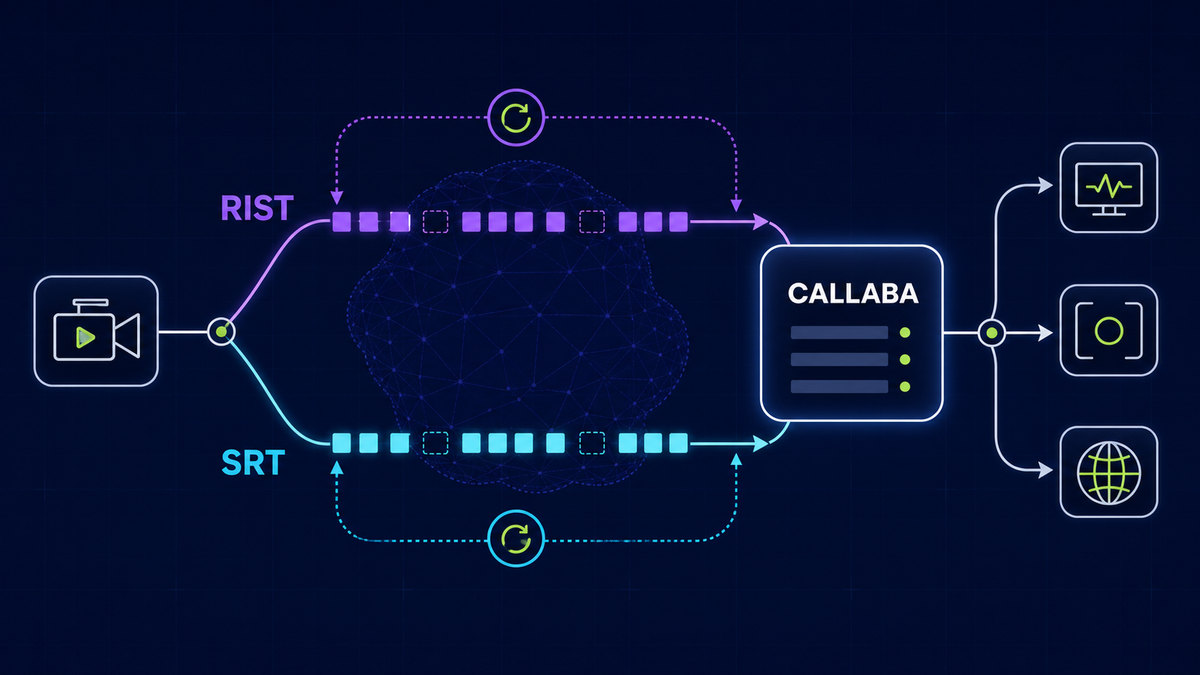
SRT vs RIST in one practical paragraph
For most teams, SRT and RIST solve similar contribution problems with different ecosystem preferences. The practical rule is simple: choose the protocol your tooling and operations can support reliably, then measure by startup, continuity, and recovery outcomes. Protocol choice is less important than runbook discipline and observability quality.
5-minute go-live checklist
- Confirm active SRT profile and route endpoint.
- Run one private contribution probe.
- Validate fallback switch and owner.
- Check startup from second device/region.
- Freeze non-essential changes before live.
FAQ
Is SRT always better than RTMP?
No. SRT is usually better for unstable contribution; RTMP remains useful for compatibility-heavy ingest.
Can SRT replace WebRTC?
Not for interaction-first two-way use cases. They solve different workflow layers.
What is the fastest reliability improvement with SRT?
Keep one tested fallback profile and enforce fallback-first incident policy.
How often should SRT profiles change?
By release cadence, not ad-hoc during live windows. Version and promote only validated changes.
What is the biggest SRT deployment mistake?
Ignoring ownership/runbook discipline and expecting protocol tuning to compensate.
Pricing and deployment path
Contribution architecture should align with cost and control requirements. For tighter ownership over routing and policy, evaluate self-hosted streaming deployment. For faster managed launch paths, compare options on AWS Marketplace. Choose by reliability targets and staffing maturity. Pricing path: validate with bitrate calculator.
Final practical rule
Use SRT where contribution reliability is the core risk. Keep boundaries explicit, rehearse fallback, and measure decisions by viewer continuity and recovery speed.