SRT: Practical Guide for Reliable Live Contribution
SRT (Secure Reliable Transport) is mainly used for live video contribution over unreliable networks. Teams choose it when RTMP-only paths become fragile under packet loss, jitter, or unstable uplinks.
Its strength is not the lowest lab latency at any cost, but more predictable recovery behavior in real network conditions. That makes SRT especially useful in remote production, multi-location events, and workflows where continuity matters more than benchmark numbers. Pricing path: validate with bitrate calculator.
This guide explains where SRT fits today, how it compares with RTMP and WebRTC, how it works in practice, and how to deploy it without constant incident firefighting.
What SRT is and where it fits today
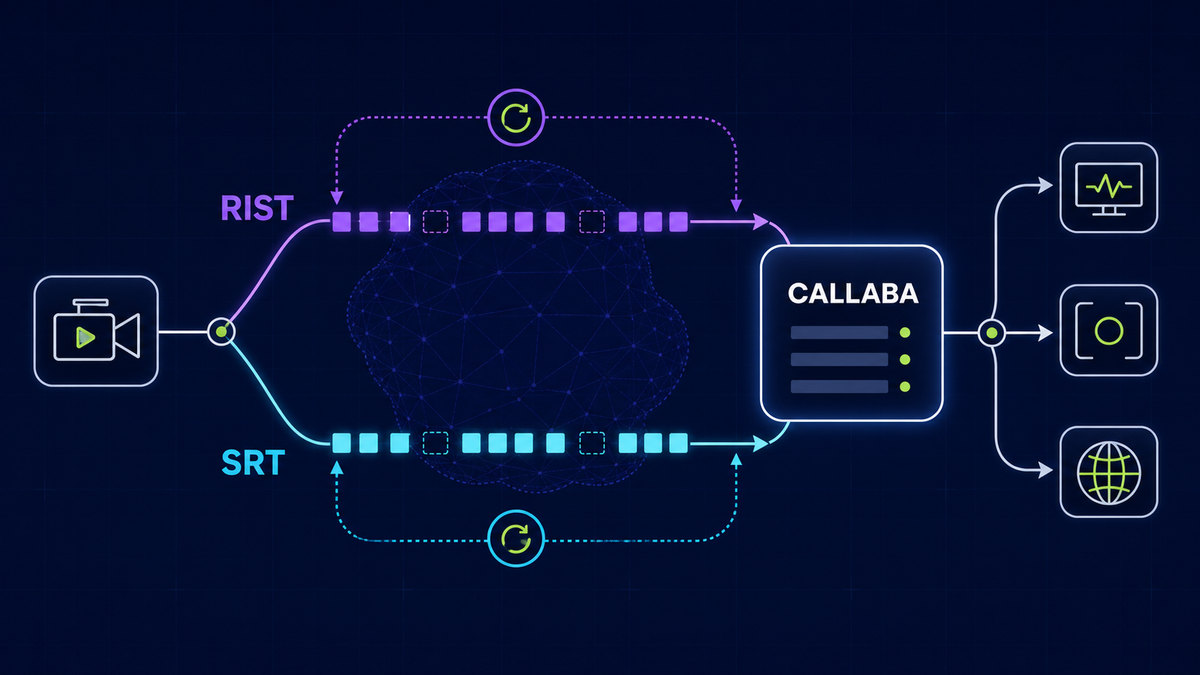
SRT is a protocol for live video transport over unpredictable networks. In modern stacks, its main role is contribution transport between source and ingest, not universal end-user playback. It is strongest where uplink quality changes during the event and operators need recoverable behavior under loss and jitter.
SRT is not a magic fix. Stable outcomes still require encoder discipline, tested fallback logic, and monitoring tied to viewer impact. If those parts are missing, transport tuning alone will not prevent recurring incidents.
- Main role: resilient live contribution.
- Best fit: remote production, unstable uplinks, multi-location workflows.
- Not ideal as standalone answer: mass audience playback and highly interactive two-way sessions.
Protocol baseline: what is SRT protocol.
How SRT works in practice
Packet recovery and latency tradeoff
SRT improves continuity by recovering from packet loss and jitter, but resilience needs latency headroom. If you push latency too low, retransmission has less time to recover and continuity degrades. If you set latency too high, responsiveness drops. Practical tuning is balancing recovery margin against real-time goals.
Connection modes
- Caller: source initiates connection to receiver; common in controlled deployments.
- Listener: ingest endpoint waits for source; useful with fixed receive boundaries.
- Rendezvous: both sides initiate; often used to handle NAT constraints in distributed environments.
Encryption and access basics
SRT supports encrypted transport with passphrase-based protection. Keep passphrase handling operationally simple: controlled ownership, scheduled rotation, and preflight validation before event day.
Firewall and network reality
Many failed SRT deployments are network-policy failures, not protocol failures. Port rules, NAT behavior, and route consistency decide whether transport settings can work at all. Validate path readiness before touching profile knobs.
When to use SRT
- Remote contribution over public internet with unstable conditions.
- Field production where uplink reliability is inconsistent.
- Multi-site event transport where continuity is business-critical.
- Workflows where resilience is more important than legacy ingest convenience.
- Teams ready to run profile governance and fallback routines.
When not to use SRT alone
- Large-scale audience playback as the only delivery strategy.
- Ultra-interactive two-way sessions where WebRTC is the stronger fit.
- Legacy-only endpoint environments where RTMP compatibility dominates.
- Cases where teams expect transport tuning to fix encoder/player design issues.
SRT vs RTMP
RTMP remains useful for compatibility and established ingest habits. SRT is usually stronger when contribution links are unstable and resilience is the priority. In practical architecture, keep RTMP where required, but isolate it at boundaries instead of forcing it as core contribution standard in volatile network conditions.
Deep comparison: SRT vs RTMP.
Bottom line: RTMP is still useful. SRT is usually stronger when contribution resilience is the real operational priority.
SRT vs WebRTC
SRT is contribution resilience. WebRTC is interaction-first delivery. SRT is usually better for moving source video into production pipelines; WebRTC is usually better for low-delay two-way sessions where audience interaction is the product requirement.
These protocols are not direct replacements. They solve different workflow layers. References: stream SRT as WebRTC, what is WebRTC.
Common SRT workflows
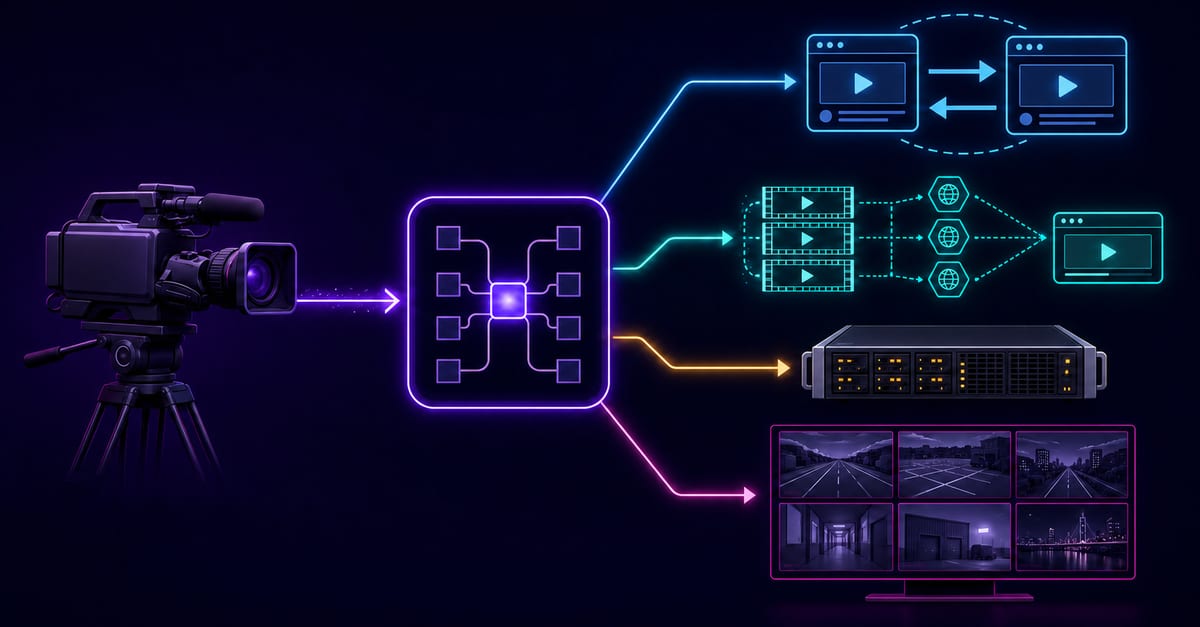
SRT contribution into managed playback
Use SRT for contribution stability, then deliver to audience through managed playback layers optimized for device coverage and continuity.
SRT to NDI
Use when remote contribution must feed NDI-based production environments. References: SRT to NDI cloud, set up NDI bridge over SRT.
SRT to YouTube
Use SRT as resilient contribution before publishing to mainstream destinations. Reference: set up SRT ingest to YouTube.
Hybrid transport boundary
Keep SRT where contribution is fragile, then translate transport at delivery boundaries where audience platform requirements differ.
SRT workflow for live teams
Preflight
- Confirm profile version.
- Confirm route target.
- Confirm source and encoder readiness.
- Assign fallback owner for the live window.
Warmup
Run a private stream with real overlays and full audio chain before public launch.
Live
Freeze non-critical changes. Allow only approved mitigation actions.
Recovery
Apply fallback first, deep retuning second.
Review
Record first-failure signal and one required improvement before next event.
SRT tuning basics
Latency
Lower latency is not always better if recovery margin disappears. Tune latency against continuity outcomes, not against one benchmark number.
Profile governance
Version profiles and freeze them before important events. Ad-hoc edits during live windows increase incident risk.
Fallback
Always test rollback path before event day. A fallback profile that was never rehearsed is not a real fallback.
Headroom
Transport settings cannot replace encoder and network headroom. Validate both under realistic scene complexity.
Practical SRT operating reference: SRT server simplified.
Observability and troubleshooting
Transport metrics matter only when tied to viewer-visible impact. Run one timeline with transport signals, playback behavior, and operator actions.
- Packet loss.
- Retransmissions.
- Latency/RTT behavior.
- Startup reliability.
- Interruption duration.
- Recovery time.
- Operator action timing.
Startup is okay, then continuity degrades
Apply fallback first, then compare transport and playback timelines in the same window.
One region is worse than others
Do not retune globally before checking route behavior and network policy in that region.
Low-latency target increases instability
Relax aggressiveness one step, retest continuity, then iterate.
The fix worked once, then the issue returned
The process failed, not only the profile. Convert fix into runbook and ownership rules.
Capacity planning and ownership
Capacity planning
- Measure baseline contribution load.
- Measure peak load during transitions.
- Keep safe operating margin instead of running at theoretical max.
- Validate recovery behavior under simulated packet loss.
Ownership
- Who owns transport profile.
- Who can trigger fallback.
- Who validates viewer-side recovery.
- Who updates runbook after review.
Execution layers for this workflow: Ingest and route for contribution and routing, Player and embed for playback surfaces, Video platform API for automation.
5-minute go-live checklist
- Verify active profile version.
- Confirm route target.
- Run one private contribution probe.
- Test one fallback switch.
- Validate viewer-side startup from a second client.
Post-run review template
- What was the first user-visible symptom?
- Which metric confirmed it fastest?
- Which fallback action was applied first?
- How long until continuity recovered?
- What one rule changes before next stream?
Pricing and deployment path
For infrastructure-control planning, evaluate self hosted streaming solution. For managed launch and procurement speed, compare the AWS Marketplace listing.
FAQ
Is SRT always better than RTMP?
No. SRT is usually stronger on unstable contribution paths, while RTMP remains useful for compatibility-heavy boundaries.
Can SRT replace WebRTC?
Not in most interactive products. WebRTC is typically stronger for two-way real-time interaction.
What is the fastest SRT reliability improvement?
Profile governance plus fallback rehearsal plus strict preflight discipline.
How often should SRT profiles change?
In planned windows with rehearsal, not through ad-hoc live retuning loops.
Is SRT enough by itself for full delivery?
Usually no. It is strongest as contribution transport and should be combined with delivery layers suited to audience playback.
What is the biggest deployment mistake teams make?
Tuning transport before validating network path ownership, fallback readiness, and operational roles.
Final practical rule
Use SRT where it is strong: contribution resilience under real network variability. Keep boundaries clear, keep fallback rehearsed, and keep one known-good profile ready for rollback.