Obs Live
More live video workflow notes and product updates.

OBS live workflows look simple in demos, but production teams need repeatable event operations, fallback paths, and measurable quality controls. This guide shows how to run OBS live sessions with predictable outcomes across webinars, product launches, and always-on channels. Before full production rollout, run a Test and QA pass with Generate test videos and a test app for end-to-end validation.
Use the bitrate calculator to size the workload, or build your own licence with Callaba Self-Hosted if the workflow needs more flexibility and infrastructure control. Managed launch is also available through AWS Marketplace.
What this article solves
Teams often experience recurring issues: one operator configures OBS differently each time, destination changes are done at the last minute, and there is no clear handoff if primary uplink fails. This article provides a concrete model to standardize live execution and reduce incident frequency.
Minimal production stack
- OBS as contribution encoder with locked presets.
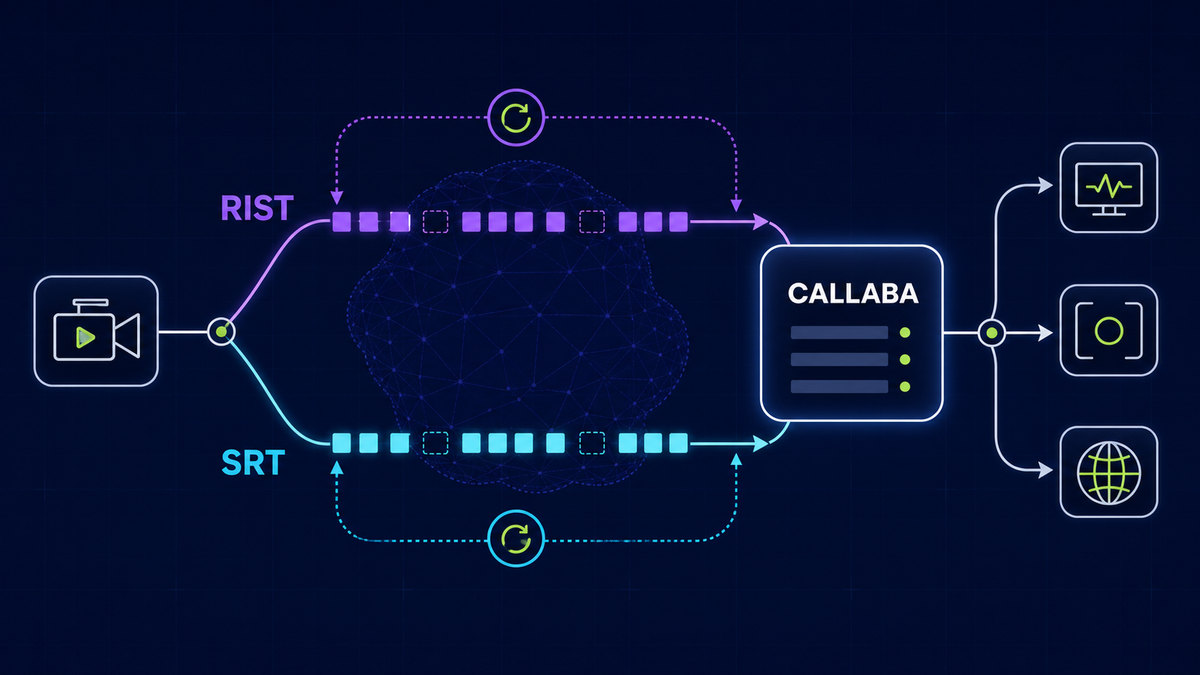
- Routing layer for multi-destination delivery and backup switching.
- Player and access layer for controlled playback and analytics.
- Recording pipeline for post-event QA and replay publishing.
Recommended product path: Ingest and route, Calls and webinars, Video platform API.
Preset strategy that scales across events
Create three approved profiles only: low-motion talking head, mixed content presentation, and high-motion demo. Each profile should define bitrate bounds, keyframe interval, audio policy, and source expectations. Avoid profile proliferation because every extra variant increases failure risk.
Pre-event runbook
- Validate scene assets and source availability.
- Run connectivity test for primary and backup contribution paths.
- Perform 10 minute dry run with full production overlays.
- Check real-time metrics: dropped frames, RTT, packet loss, encoder load.
- Confirm incident roles and communication channel.
During-event guardrails
- Limit live configuration edits to predefined emergency changes.
- Track quality KPIs in one dashboard owned by one operator.
- Use routing layer for destination adjustments, not OBS scene surgery.
- Trigger failover by objective threshold, not subjective visual guess.
Post-event review that improves future sessions
Run a short retrospective with real data. Compare planned profile to observed metrics and document deviations. Feed findings back into preset definitions and runbook steps. This creates compounding reliability gains over repeated events.
Typical mistakes and fixes
- Mistake: one universal profile for all content.
Fix: separate profiles by motion and visual complexity. - Mistake: no backup ingest path.
Fix: pre-validate secondary route and operator handoff procedure. - Mistake: no correlation between support tickets and stream metrics.
Fix: connect incident logs to playback analytics and ingest telemetry.
When to move beyond a manual OBS workflow
If your team runs many sessions per week, automate event provisioning and policy checks via API. Manual copy-paste configuration does not scale and introduces silent drift in output quality. API-driven provisioning keeps session setup consistent and auditable.
A practical trigger for automation is repeated incident type. If the same configuration mistakes appear across multiple events, move those settings from human memory into system policy. Use templates for scene packs, profile presets, and destination bundles so each event starts from a verified baseline instead of a custom one-off setup.
Also standardize event roles. A producer should not be the same person watching packet-loss telemetry and failover thresholds. Splitting creative and operational duties improves response speed and avoids delayed decisions during quality degradation windows.
Related implementation guides
See OBS Studio reference, live platform design, stream setup checklist, and WebRTC delivery tradeoffs.