Live Streaming Services
More live video workflow notes and product updates.

Use the bitrate calculator to size the workload, or build your own licence with Callaba Self-Hosted if the workflow needs more flexibility and infrastructure control. Managed launch is also available through AWS Marketplace.
What this article solves
Teams often compare feature lists only. In practice, successful rollout requires protocol fit, failover model, observability, and a clear path from audience growth to stable operations.
Evaluation framework
- Define delivery targets: public reach, private access, paywall, or hybrid.
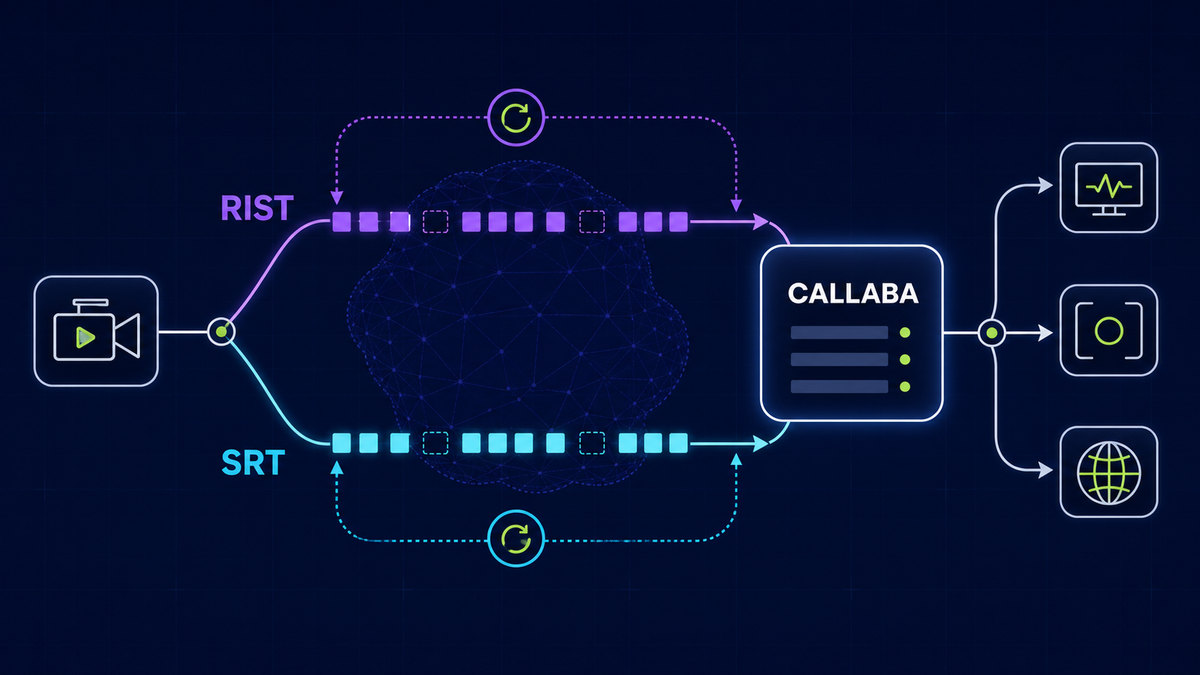
- Validate ingest compatibility: SRT, RTMP, WebRTC, and API control.
- Check latency tiers for each workflow, not marketing averages.
- Assess reliability model: backup ingest, multi-destination routing, replay.
- Measure operational overhead: setup time, monitoring depth, incident recovery.
Product mapping for this workflow: Ingest and route, Paywall and access, Player and embed.
Architecture patterns
Event-driven live
Use controlled ingest with standby inputs and post-event VOD conversion for replay and SEO continuity.
Always-on channels
Use scheduled playlists, health checks, and low-touch operations with alerting and on-call runbooks.
Interactive sessions
Reserve low-latency path for interaction layers while keeping stable distribution path for the broader audience.
Further reading: streaming platforms guide, continuous channels strategy, WebRTC fundamentals.
Cost and scaling controls
- Separate traffic, storage, and transcoding costs in planning.
- Use profile-based encoding standards to limit drift and support load.
- Track per-channel availability and incident minutes as business metrics.
Common pitfalls
- Single-path ingest with no failover.
- Mixing interactive and broadcast requirements into one pipeline.
- No API automation for channel provisioning and teardown.
Practical rollout plan
- Start with one representative workflow and baseline metrics.
- Add backup ingest and alerting before scaling destinations.
- Expand to monetization and VOD reuse once delivery is stable.
- Automate provisioning and policy checks through API.
Next step
Continue with live platform checklist, service comparison details, and Video platform API.